


As of December 1, 2025, significant changes have been introduced to the system of protecting geographical indications. Now, in accordance with the provisions of the European Union Regulation (EU) 2023/2411, it is possible to obtain registration for handicrafts and industrial products as geographical indications.
What is involved in registration of handicrafts and industrial products as geographical indications?
The above change does not only allow to protect heritage, but it also combines tradition with innovation, the old with the new. The system aims to support local economies, while simultaneously respecting tradition and promoting a given region.
What is important, for the first time a system is introduced that will protect not only the rights and interests of large companies, as is the case with trademarks or patents, but also small local entrepreneurs, giving them the opportunity to become recognizable. This recognition will be based on the heritage of a particular region, providing the entrepreneur with an unprecedented opportunity to make itself famous outside the region of origin.
One can already find worldwide the examples of economies built around local products based on raw materials originating from a given territory. The change that is coming into force opens new opportunities for many regions, and there is much hope that these opportunities will be exploited properly.
What exactly are geographical indications?
Geographical indication – a legally protected name of a product originating from a specific place, region, or country and owing its characteristics, quality, or reputation to its specific origin.
Thus, a geographical indication protects the name of a product with a specific geographical origin that owes its characteristics and/or reputation to that specific origin.
The characteristics of the product are inseparably linked to this area, e.g. the climate, soil, traditional production methods, or local know-how. The geographical area may refer to a specific place, region, or country. Unlike a trademark, there is no commercial indication here, but rather an indication of geographical origin.
A product meets the requirements for registration as a geographical indication if it comes from a specific place and its quality, reputation, or other characteristic is essentially connected with its geographical origin.
Geographical indications perform an informative, distinguishing, advertising, and guaranteeing (quality) function. The products protected by geographical indications must demonstrate consistent quality resulting from their characteristics that shall be specified in the application for registration.
This type of protection right applies to various categories of goods – agricultural products and foodstuffs, wines, spirits, mineral waters, and from now also to handicrafts and industrial products.
Protected Designations of Origin and Protected Geographical Indications
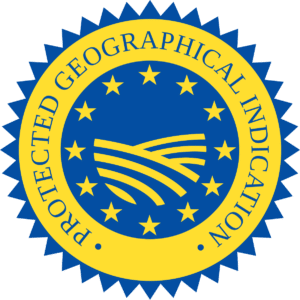
In the European Union, a distinction is made between Protected Designation of Origin (PDO) and Protected Geographical Indication (PGI), depending on how strong the connection is between the characteristics of the product and its origin. The recognizable EU logo helps consumers make aware purchasing decisions by choosing authentic, high-quality products.
 |
 |
|
Protected Designation of Origin (PDO) |
Protected Geographical Indication (PGI) |
| Products: agricultural products and wine. |
Products: handicrafts and industrial products; agricultural products and wine. |
| Polish names registered as PDOs:
Bryndza Podhalańska [highlands sheep rennet cheese from Podhale Region in Southern Poland] Karp zatorski [Carp fish from the locality of Zator] Podkarpacki miód spadziowy [honeydew honey from Podkarpacie Region in Southern Poland] Oscypek [the Polish highlands smoked cheese from the mixture of sheep and cow’s milk]. |
Polish names registered as PGIs: Cebularz lubelski [onion cake made in the city of Lublin] Truskawka kaszubska [Kashubian strawberry] Obwarzanek krakowski [Cracow Bagel] Suska sechlońska [a smoked pitted plum grown in Southern Poland] Ser koryciński swojski [traditional cheese from the locality of Korycin in Eastern Poland] |
What handicrafts and industrial products can be registered as geographical indications?
Until now, the EU system for protecting geographical indications mainly covered agricultural products, foodstuffs, wines, and spirits. The new rules allow for the protection of products such as ceramics, glassware, leather goods, jewelry, furniture, textiles, and clothing.
The only product registered as a Polish geographical indication for industrial products at the Polish Patent Office in 2022 is “the lace of Koniaków” (“koronka koniakowska”), which is the only tradition of its kind in Poland to receive such protection.
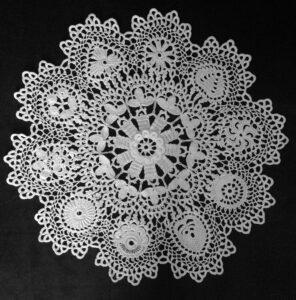
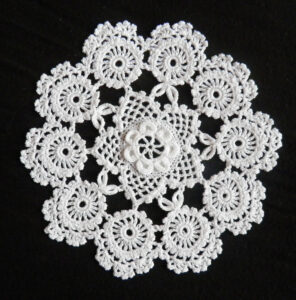

Source: https://centrumkoronkikoniakowskiej.pl/sklepik/
How can we characterize the new categories of products that will be eligible for protection?
The products eligible for protection shall be characterized as follows:
A handicraft – produced entirely by hand or using hand tools or digital tools or mechanical means, if the imput of manual labor is an important part of the final product;
or
industrial product – produced in a standardized manner, including within series production and by means of machines.
Which authority is responsible for registration of geographical indications for handicrafts and industrial products, and what does the procedure look like?
It is the European Union Intellectual Property Office (EUIPO) that is responsible for the system of application and registration of geographical indications for handicrafts and industrial products.
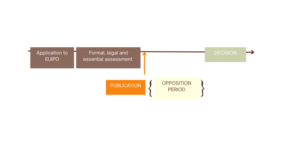
The procedure of registration involves two stages:
- The national stage: a group of producers files an application to the competent national authority – in Poland, it is the Patent Office of the Republic of Poland.
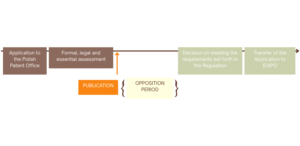
- The European Union stage: after a positive assessment at the national level, the application is forwarded to EUIPO for further verification and registration in the EU register.
Where is the protection of handicrafts and industrial products as geographical indications effective, and what does it cover?
The grant of protection is effective throughout the entire European Union. A registered geographical indication is protected indefinitely in time. The obtained right protects against any misuse, imitation, or reference to the protected name. The protection of geographical indications enables the holder to combat effectively the acts of counterfeiting and unfair commercial practices.
Any association consisting mainly of producers of the same product may apply for protection. Producers may apply for a single intellectual property right valid in all EU Member States by means of a single application.
Who can apply for protection of handicrafts and industrial products?
Any producer who meets the conditions set out in the product specification is entitled to use the registered geographical indication.
Under certain conditions, an application for protection right may be submitted by a single producer (if it is the only producer of a given product in the region), or by a public or private law entity.
What handicrafts and industrial products may obtain protection in the form of geographical indications? Examples
The examples of products that are eligible for protection as geographical indications:
– fabrics, e.g. the Scottish tweed from the Isle of Harris, known as the “Harris Tweed”:

Source: https://pewienpan.pl/Harris-Tweed-legendarne-welny-ze-Szkocji-blog-pol-1558710634.html
– clothing, e.g. traditional regional costumes:

Source: https://mazowsze.waw.pl/historia-kostiumow
– ceramics and glass, e.g., pottery from the town of Bolesławiec, glassware from the island of Murano, crystals from the town of Krosno:
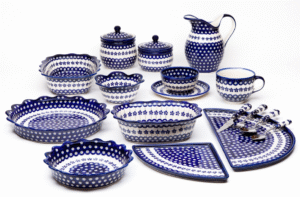
Source: https://muzeum.boleslawiec.pl/producenci-ceramiki-boleslawieckiej/
– jewelry, e.g. the Baltic amber jewelry;
– furniture;
– natural stone, e.g., Carrara marble or striped flint:

Source: https://www.swkatarzyna-muzeum.pl/krzemien-pasiasty/opis/
What does the newly implemented EU regulation provide by allowing the protection of handicrafts and industrial products as geographical indications?
The new regulations constitute a breakthrough in the protection of European cultural and industrial heritage. The introduction of the system is not only a favor towards smaller enterprises (SMEs), but it also provides real assistance in obtaining protection for their unique products, which previously used to be complicated and costly.
The changes will also improve the enforcement of the regulations on geographical indications, including in the digital environment, which will help combat counterfeiting and dishonest use of product names on the Internet. Having the status of a registered geographical indication contributes to the growth of reputation and market value of a product, which directly translates into economic benefits for local producers. Consumers, in turn, will gain greater certainty about the origin and authenticity of the characteristic properties of the protected products.
The new regulations supporting the protection of handicrafts and industrial products will undoubtedly contribute to the preservation of cultural heritage and the promotion of local traditions.
Sources:
– Regulation (EU) 2023/2411 of the European Parliament and of the Council of October 18, 2023, on the protection of geographical indications for handicrafts and industrial products and amending Regulations (EU) 2017/1001 and (EU) 2019/1753 (https://eur-lex.europa.eu/legal-content/PL/TXT/HTML/?uri=OJ:L_202302411),

Joanna Rafalska is a patent attorney in Trademark and Industrial Design Department at Patpol. She graduated from law at the Catholic University of Lublin, and completed post-graduate studies in intellectual property law at the Jagiellonian University. At Patpol, she supports the work related to obtaining and maintaining protection of trademarks and industrial designs of our clients. Contact with the author