


Upon making the study of history of champagne, known as “the wine of civilization,” its theme in art and pop culture, as well as the controversies surrounding it, one can indeed see the broad impact that this alcohol has and the recognition it enjoys. Champagne owes its exceptional fame and reputation to its extraordinary taste, advertising and promotion, and probably also to the combined efforts of winemakers and merchants, as well as the French themselves and their approach to their regional products and food.
”A writer, politician, and gentleman agree that champagne is an everyday pleasure for those who know what life is all about!” (Winston Churchill).
The creator or discoverer of champagne, a sparkling wine from Champagne, is considered to be the Benedictine monk Dom Pierre Pèrignon, because he invented a process that made it possible to obtain a smooth foam during champagne production using a new method of pressing wine: the “champagne method.” He was the first to bottle wine and the first to produce white wine from black grapes. Some also credit him with developing the traditional method of producing sparkling wines, i.e., the champagne method, which involves a second fermentation in bottles of still wine after the addition of liqueur de tirage.
Champagne is not the only alcohol produced using this method, but in 1994, the winemakers from Champagne successfully lobbied the EU to restrict the use of the term “Champagne method” exclusively to wines produced in their region. Other French regions must now use the term “traditional method,” while other EU countries producing sparkling wines have adopted their own names: cava, prosecco, sekt.
Since the 18th century, champagne has gained international recognition thanks to the owners of famous “champagne houses,” starting with Maison Ruinart, Florenz-Louis Heidsieck, and Claude Moët, followed by Pierre Nicolas-Marie Perrier-Jouët, the Bollinger family, and the ladies Pommery, Perrier, and Cliquot. No historical event in the 18th and 19th centuries was complete without champagne. It was used to celebrate the storming of the Bastille, was present at the Congress of Vienna, and was served to guests at royal weddings and world’s greatest fairs.
The great success of champagne attracted both enthusiasts and fraudsters. Fraud consisted of not following the recipe for champagne or using the name for wines not originating from Champagne. As early as 1887, the SCVC (French: “Syndicat du commerce des vins de Champagne” – Champagne Wines Merchant Association) sought to eliminate fraud in the Champagne region itself – the conditions and rules for using the name “champagne” were defined, and all champagne houses that did not comply with the rules were excluded from its ranks. In the same year, the Court of Appeal in Angers confirmed the exclusive right to use the word “Champagne” for wines from the Champagne region: “Champagne wines or champagne may only be used for wines harvested and produced in Champagne, a former province of France, defined geographically and whose boundaries cannot be extended or restricted.” In addition, winemakers and champagne houses made efforts to obtain Appellation d’Origine Contrôlée (AOC – Protected designation of Origin) certificate of authenticity and entry on the list of protected products. Champagne obtained Appellation d’Origine Contrôlée (AOC) status, i.e., it became a protected designation of origin under the decree of June 29, 1936.
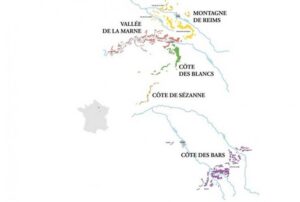
The territory of the Champagne Region in France.
France has divided its wines into several categories according to their respective levels of quality, regulation, and control. In Champagne, there are three protected names of the designations of origin: AOC Champagne, AOC Coteaux champenois (red, rosé, or white, still wines made from the same grapes as champagne); AOC Rosé des Riceys (rosé wine produced exclusively in the commune of Riceys in Aube). Since 1941, the protection of the product names has been handled in France by the Interprofessional Committee for Champagne Wine (CIVC – Comité Interprofessionnel du Vin Champagne) together with the National Institute of Origin and Quality (INAO). Currently, all European Union countries and many other countries, such as South Korea, Canada, Brazil, and Colombia, grant protection to the name “champagne”, while a number of other countries such as the US and Russia do not recognize it at all, or only to a very limited extent.
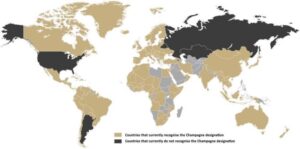
The countries that do not recognize the name “champagne” as a protected designation of origin are marked in black, while the countries where protection is recognized are in beige.
The threats to champagne’s reputation are both internal, within France itself, and external.
The internal threats relate to the word “champagne” without actually indicating the product bearing this name, e.g., “a wonderful wine harvested outside Champagne.” Another threat that infringes on the rights to the name “champagne” is the registration of trademarks containing the word champagne: “Sirops de Champagne,” “Grenadine – Champagne,” “Bière- Champagne,” “Lait- Champagnisè,” “Limonade-Champagne,” but also “ Champagne cordial” as an aperitif or trademarks for perfumes that are “oils and essences of champagne quality.” It should be remembered that “Champagne” is a protected (or controlled) designation of origin, but the word is not registered as a trademark, as any producer of a beverage made in Champagne from local grapes may use this name, provided that they meet all production requirements. Trademarks, on the other hand, are registered on behalf of a specific manufacturer to designate goods or services. However, CIVIC claims that champagne is also an unregistered but widely known trademark and, as such, remains protected. CIVIC’s main objective is to completely eliminate the use of the term “champagne” by manufacturers of any goods and services other than champagne. This is not easy, but CIVIC effectively protects the designation “champagne,” for example, in a dispute in Germany with the advertising campaign for Perrier mineral water, where the reputation of champagne was used in the advertising slogan “The champagne among mineral waters” in reference to Perrier – CIVIC claimed that the reputation of champagne was exploited here.
Another interesting dispute took place in the United Kingdom concerning sparkling elderflower juice sold in champagne-shaped bottles with the words “Elderflower Champagne” on the label. In this case, CIVIC emphasized that “the reputation and renown of champagne results not only from the quality of the wine, but also from the uniqueness and exclusivity of the description itself, the absence of any other epithets or descriptive terms. Therefore, any product that is not champagne but uses that name inevitably undermines the uniqueness of champagne, causing insidious but serious damage.”
Another dispute between CIVIC and the discount chain Aldi Süd concerned the discontinuation of sales of ice cream under the name “Champagner Sorbet.” The Munich court ruled that the dessert could not use the term “champagne flavor” if it did not taste like sparkling wine.
CIVIC was also involved in a number of cases where the allegations were based on parasitic exploitation of the reputation of champagne. As early as 1984, the Paris Tribunal de Grande Instance ruled for the first time on the misuse of the reputation of a designation of origin in a dispute concerning the use of the name “Champagne” to designate cigarettes sold under the name “Champagne.” A similar situation concerned the perfume “Champagne de Yves Saint Laurent,” which was created for “light, happy, and lively women” and quickly became the third best-selling fragrance in Europe. The lawsuit filed by CIVIC resulted in the perfume being renamed “Yvresse.”
Another interesting case involved the photos of a new iPhone 5S in the light gold color, which was to be advertised as “the color of champagne.” CIVIC immediately warned Apple against using this name for the color because “French sparkling wine comes in many different shades. Therefore, any company that wants to use the name ‘Champagne’ would only do so to take advantage of the wine’s reputation.”
It is safe to say that CIVIC monitors the entire world and nothing related to champagne escapes its attention. An example of this is the case of a married couple in Australia who were involved in delivering gift baskets, packaging and selling exclusive products, including champagne. When they wanted to register their company name “Champagne Messenger” in Australia, they received a warning letter from CIVIC stating that this trademark infringed the protected designation of origin ‘Champagne’ in Australia and would be detrimental to the interests of champagne producers. Consequently, the Australian couple changed their company name to “Bubbly to Go.”
CIVIC is so firmly committed to protecting the reputation of the “wine of civilization” that it did not even make concessions in a dispute with winemakers from a small town of Champagne in Switzerland, with a population of 1,000, who unsuccessfully appealed to the EU for permission to use the name “Commune de Champagne” for their local wines produced in the Vaud region. However, the agreement between Switzerland and the EU on agricultural products contains regulations stating that the name “champagne” is reserved only for wines from Champagne in France and cannot be used by other manufacturers as of today. CIVIC also has 27 Gtld and ccTLD internet domains consisting of the word “champagne” and 101 domain names that contain the word “champagne” as part of the name, e.g.: champagne.fr; champagne.co.uk, champagne.eu; champagne.com. However, the lack of clear and unambiguous international legal regulations may lead to inconsistent assessments of infringements. The French and Belgian courts consider the registration of domains referring to the name “champagne” to be an infringement . For example, the Paris District Court ruled that the domain name and website address www.champagne.com and the name “champ.pagne” constitutes unlawful use of the protected designation of origin Champagne and damages and undermines the reputation of that name.
It should also be remembered that champagne is a protected designation of origin, not a trademark, and according to the opinion of WIPO and the Uniform Dispute Resolution Policy, protection does not extend to geographical indications in domain name cases, unless the complainant can demonstrate that “he has rights to the designation (name) and that it is used as a trademark for goods or services other than those described or associated with the geographical meaning of the name.”
Currently, the biggest problem for CIVIC is the fear of losing the unique character and reputation of the name “champagne,” because not everyone knows that “champagne” is a protected designation of origin. It is worth mentioning here the amendment to the federal law on state regulation of the production and sale of ethyl alcohol, alcoholic products and products containing alcohol, and on the restriction of alcohol consumption, signed in 2021 by Russian President Vladimir Putin. This amendment required champagne producers to change the name “champagne” to “sparkling wine” on the back label of bottles, written in Cyrillic, with the reservation of the Cyrillic name “Champanskoye” for Russian sparkling wine producers. Russia’s move naturally outraged the French, but within two days, the French company LVMH Moët Hennessy, owner of Veuve Clicquot, Moët & Chandon, and Dom Pèrignon champagnes, agreed to comply with Russian legislation in order to continue exporting champagne to Russia. The outbreak of war in Ukraine caused French champagne producers to withdraw from this market.
To sum up the above mentioned history of champagne’s reputation and the proactive efforts of the Interprofessional Committee of Champagne Wine (CIVC), when creating a trademark it is important to check beforehand whether it does not infringe any protected designations of origin, such as champagne. Individual countries, including Poland and the European Union, have the lists of protected designations of origin and registered geographical indications both in the EU and in the respective countries. It is worth checking these lists to make sure that we do not infringe any protected designations of origin or geographical indications.
In Poland, the Ministry of Agriculture and Rural Development maintains the list of products registered as Protected Designations of Origin, Protected Geographical Indications, and Guaranteed Traditional Specialties. Link: www.gov.pl/web/rolnictwo/produkty-zarejestrowane-jako-chronione-nazwy-pochodzenia-chronione-oznaczenia-geograficzne-oraz-gwarantowane-tradycyjne-specjalnosci .
In the European Union, information on protected designations of origin and geographical indications can be found under the following link: www.agriculture.ec.europa.eu/farming/geographical-indications-and-quality-schemes/geographical-indications-and-quality-schemes-explained_pl .

Agnieszka Skrzypczak is a patent attorney specializing in trademarks and industrial designs. In 2002, she obtained the rights of a Polish Patent Attorney, and since 2004, she is also a European Patent Attorney. She is a member of INTA (International Trade Marks Association) and PIRP (Polish Chamber of Patent Attorneys). Contact with the author